























































Insulated Pan Carriers: How to Get Hot Food There Still Hot
Teighan Graves2026-09-10T13:51:17+10:00Hot or cold. Four hours. No power.
Most kitchens cook and serve in the same building. Plenty of hospitality doesn’t work that way. The function room is across the car park, the residents are on level three, the event is 40 minutes up the highway, the canteen serves from a servery the kitchen can’t see.
Every one of those trips is where temperature gets lost, and temperature is the part the health inspector asks about.
What do the food safety rules require in transit?
Under Standard 3.2.2 of the Australian Food Standards Code, potentially hazardous food has to be kept at 5°C or colder, or 60°C or hotter, while it is stored, displayed, received and transported. Getting it out of the kitchen at the right temperature isn’t the end of the job. It has to still be there when it arrives.
Food Standards Australia New Zealand names insulated containers as an accepted way to hold temperature in transit, along with checking the food with a clean, sanitised thermometer rather than assuming. An operator who can produce a reading has a records trail. One who can only say “it seemed hot” doesn’t.
How does an insulated pan carrier work?
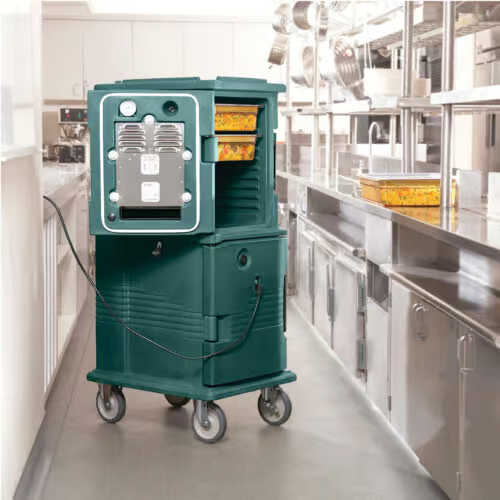
No power, no batteries, no plug. An insulated pan carrier is a thick-walled box that slows heat moving in or out. You load it with food already at a safe temperature and it holds that temperature for a few hours.
Two things follow, and they are the two things people get wrong.
It holds, it doesn’t heat. Load food at 55°C and you are starting below the line and going down. Load it at 70°C and you have room to move.
Insulation works both ways. The same box that keeps a roast hot will keep a salad or a dessert cold. Most operators buy one for hot food and end up using it just as often for cold.
A well-built carrier holds roughly four hours. One of the units below is rated from 80°C down to 68°C over four hours, and from 0°C up to only 6°C over the same time.
EPP or polyethylene with foam?
Expanded polypropylene (EPP) is the lighter option. It resists impact, water and cleaning chemicals, and it is recyclable. If staff are lifting carriers in and out of a van several times a day, weight stops being a detail and becomes a workplace health issue.
A polyethylene shell with a polyurethane foam core is the heavier, tougher build: thick outer wall, foam core, scratch and corrosion resistant. This is the one for operations that treat equipment roughly and expect it to last regardless.
Neither is better in the abstract. It depends on whether your bigger problem is staff lifting or gear getting flogged.
Front load or top load?
Front-loading carriers open like a cupboard. You can pull the second pan from the bottom without unstacking the ones above it, which matters during service. They also stack for storage.
Top-loading carriers are usually shallower and lighter, suited to a single tray going a short distance.
For anything multi-pan, front load wins on the floor.
What to check before you buy
- Capacity in gastronorm. Don’t think in litres, think in pans. Check the runner spacing against the pan depths you actually run.
- A door seal and a vent. A removable gasket seals the box. A pressure relief valve lets steam out so the door doesn’t blow and the food doesn’t turn to soup.
- A built-in thermometer. Every time you open a carrier to check, you dump the heat you were trying to keep. Reading it through the door removes that trade-off and gives you a number for the record.
- A removable door. A door that comes off is a door that gets cleaned properly.
- Stackability. Storage space is why carriers end up unused in the back of a shed.
- A matching dolly. A loaded six-pan carrier is a two-person lift. On a dolly it is one person, and the carrier is off the floor.
Five things that cost you temperature
- Loading food that is only just warm. Start hot. You can’t recover it later.
- Half-empty pans. A full pan holds temperature far better than a third of one. Consolidate before you load.
- A cold carrier on a cold morning. Pre-warm with a hot pan, or pre-chill for cold work, and you buy time on a long run.
- Opening the door to look. Every open resets the clock. This is the argument for the built-in thermometer.
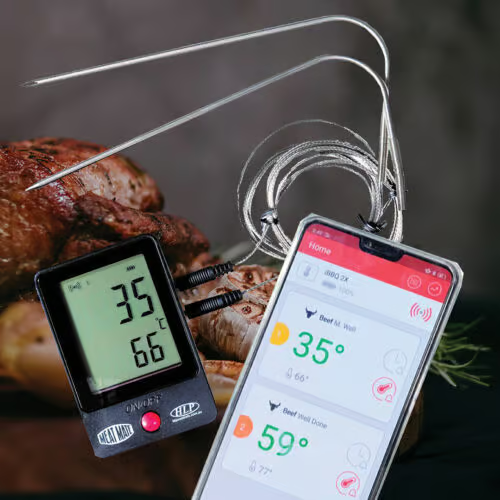
- No probe on board. If you can’t measure it, you can’t prove it. Keep a probe thermometer with the carrier, not in the kitchen drawer.
The carriers we stock
These are stocked lines at Hospitality Superstore, not special orders, and they are on the floor in our Hamilton showroom where you can open them up and look at them.
KH Insulated Pan Carrier, Front Load (16167)
The heavy-duty one. Double-walled polyethylene with a polyurethane foam core, large latch, removable gasket and a pop-up pressure relief valve. Takes 6 x 1/1 GN x 65mm pans, or fewer deeper ones. Shock resistant and stackable. This is the carrier for van fleets and high-volume caterers.
KH EPP Insulated Pan Carrier, Front Load (16272)
The one with the built-in thermometer. Read the internal temperature without opening the door. EPP construction so it is lighter to handle, with a 270° door that lifts off completely for cleaning, side grips, a locking clip and a sealed interior. Takes stainless, plastic or foil trays. Worth a look for anyone keeping formal food safety records.

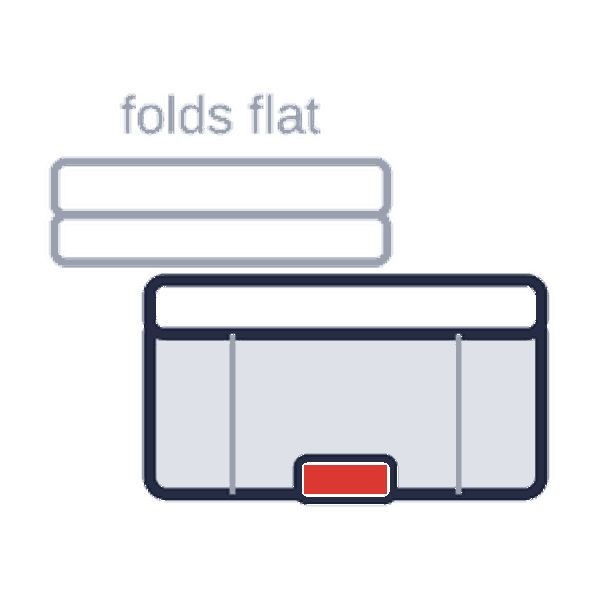
EPP Foldable Insulated Box, 1/1 GN (16293)
Folds flat when it is empty. Holds one 1/1 GN pan, hot or cold. This is the answer for cafes, food trucks and small caterers who need to move a tray occasionally but have nowhere to store a full-size carrier. Available by the carton.
KH Dolly to Suit Pan Carrier (16170)
Fits the 16167 and the 16272. Recessed platform so the carrier sits locked in place, braked swivel castors, heavy-duty build. Buy it with the carrier, not after someone hurts their back.

Which one suits your operation?
| If you are | Recommended SKU code |
|---|---|
| An off-site caterer with a van | 16167, plus the 16170 dolly |
| Aged care or a hospital running satellite service | 16272 for the temperature records, plus the 16170 dolly |
| A school canteen or tuckshop | 16167 for volume, 16293 for one-tray runs |
| A pub or club serving function rooms away from the kitchen | 16167 or 16272, on a 16170 dolly |
| A food truck, market stall or sporting club | 16293 |
| A meal delivery or meal prep business | 16293 by the carton |
Frequently asked questions
How long will an insulated pan carrier hold temperature?
Around four hours for a quality unit, assuming you load the food at a safe temperature and keep the door shut. Real figures on one of the units Hospitality Superstore stocks: 80°C down to 68°C after four hours hot, and 0°C up to 6°C after four hours cold.
Do insulated pan carriers need power?
No. They are passive insulation. Nothing to plug in, nothing to charge, nothing to fail on the road.
Can I use the same carrier for hot and cold food?
Yes. Insulation holds whatever temperature you load. Clean it properly between uses and don’t mix hot and cold loads in the same box at the same time.
Will it fit my existing gastronorm pans?
The carriers here take standard 1/1 GN pans. The EPP unit also handles plastic pans and foil trays, which suits caterers who send trays out and don’t get them back.
What temperature does the law require?
5°C or colder, or 60°C or hotter, for potentially hazardous food. That applies in transit, not just in the kitchen.
Do I still need a thermometer if the carrier has one built in?
Yes. The built-in thermometer reads the air inside the box. A probe reads the food. Use the built-in one to monitor without opening the door, and a probe to verify.
Want to see one in person? Visit our showroom
Specifications only tell you so much. These are on the floor in the Hospitality Superstore showroom at Hamilton in Brisbane, and the fastest way to work out which one suits your operation is to open the doors, check the pan spacing against what you actually run, and pick one up.
Our team can also sort the rest of what goes with it, gastronorm pans and lids, probe thermometers and cleaning chemicals, so the carrier arrives ready to work.
Browse the full insulated carriers range » or call the team on 1300 721 694.
Temperature requirements referenced from Food Standards Australia New Zealand, Standard 3.2.2 of the Australian Food Standards Code. Always check current requirements with your local council or state food authority.